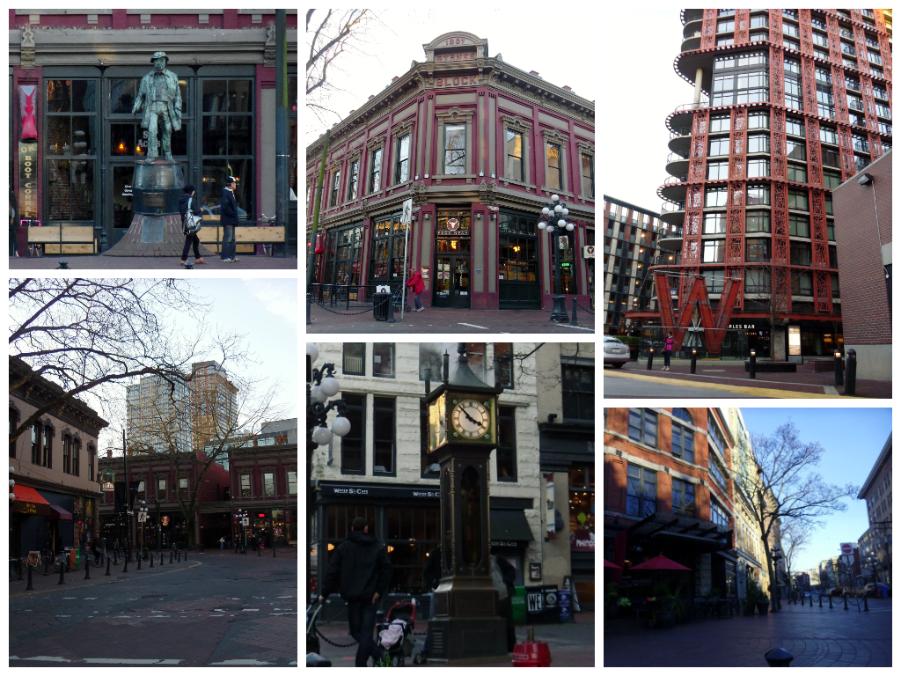
About Gastown
In the late 19th century, Gastown was the center of the new city of Vancouver (Boudreau, 2012). It is now a small historic district embedded within the broader community of Vancouver’s Downtown Eastside (DTES) (Smith, 2003). Gastown, named for Gassy Jack Deighton who opened Vancouver’s first saloon, is home to an eclectic mix of restaurants, bars, condominiums, and chic boutiques lining the iconic cobblestone streets (Clement, Campbell, & Kealey, 2012). As can be seen in the map below, the official boundaries of Gastown are irregular; however, this district comprises most of the area from Hastings Street to the north, Richards Street to the west, Main Street to the east, and Cordova Street to the south (City of Vancouver, 2012).
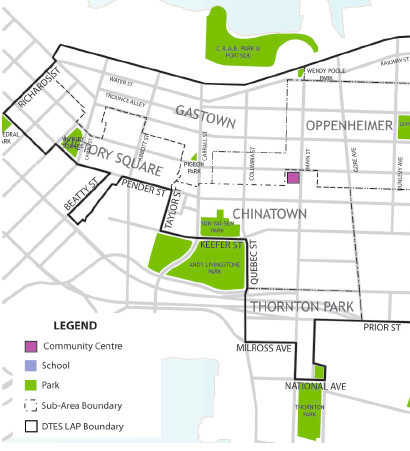
(City of Vancouver, 2012)
Gastown is the site of some of Vancouver’s oldest structures, but by the 1940s the area had been neglected and allowed to decay to such an extent that it became the center of the city’s skid row (Boudreau, 2012). Since 1968, various business and city-planning groups have undertaken a rehabilitation of the area, turning it into an expanding commercial district and profitable tourist destination (Boudreau). While the neighbourhood has undergone extensive commercial and residential revitalization it has also experienced worsening poverty, social disadvantage, increasing crime rates, and creation of an open-air drug market (Smith, 2003). Gastown is an area undergoing gentrification, defined as a shift in an urban community toward wealthier residents and businesses, in addition to increasing property values, often to the detriment of poorer residents of the community (Roe, 2009).
Gastown’s vibrant day and night life coupled with its iconic historic architecture make it a trendy place for tourists to visit as well as for locals to live (Smith, 2003). The residents of Gastown are primarily English speakers of Caucasian descent, and just under half of them hold university degrees (Gastown Neighbourhoods, 2009). Gastown is also a densely populated neighbourhood averaging 10,500 people per square km, well above the Vancouver average of 735 people per square km (Statistics Canada, 2006). In 2006, the average cost to purchase property in Gastown was $304,399, which was significantly lower than the Vancouver average of $520,937 (Statistics Canada). Gastown has an average household income of $33, 877, much lower than the Vancouver average of $64, 332 (Statistics Canada). This lower than average income level in Gastown could explain the above-average population of renters: 69% of people rent in Gastown compared to 53% in the greater Vancouver area (Statistics Canada).
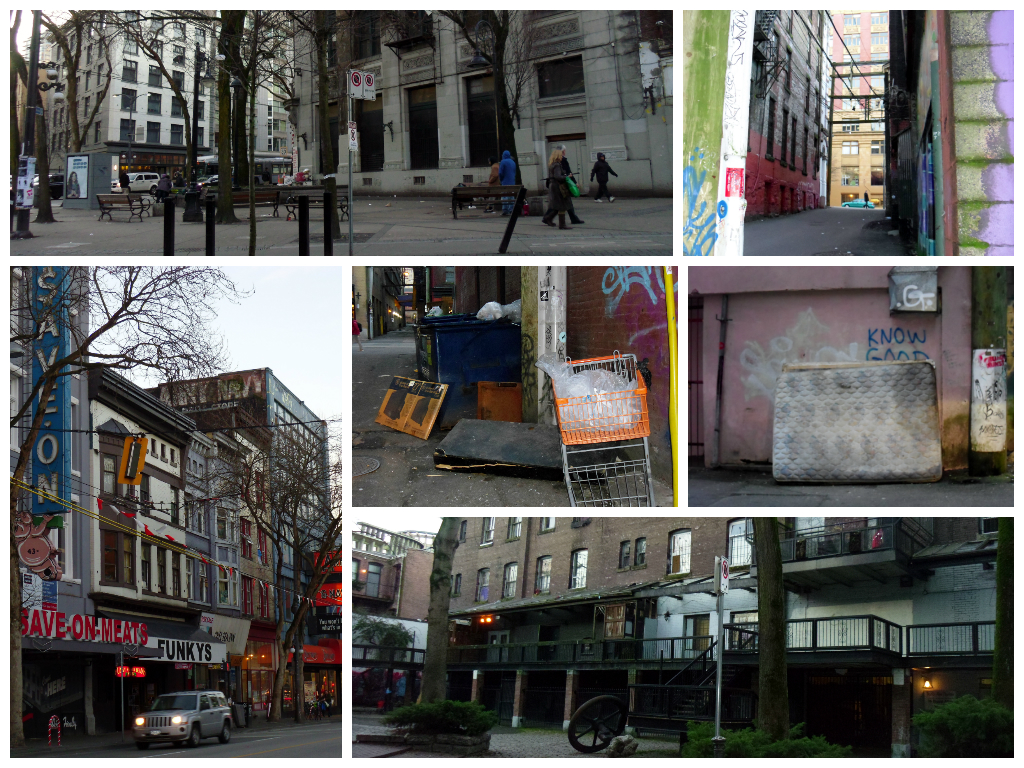
The aforementioned income, housing ownership, and cost of housing statistics are typical of neighbourhoods undergoing gentrification and revitalization (Roe, 2009). As a result of these processes, many low-income individuals lack the ability to keep up with the socioeconomic growth in the area, which can lead to low-income residents being displaced from the community into other neighbourhoods that may offer a lower standard of living (Roe). The process of gentrification also leads to a growing socioeconomic divide between the "haves" and the "have-nots" in this historic neighbourhood (Smith, 2003).
The following Youtube videos provide two perspectives of contemporary Gastown. In the first video, produced by Tourism Vancouver (2013), we see a tourist-friendly and positive spin on this neighbourhood. Conversely, the second independently-produced video also gives a glimpse into the underbelly of Gastown, which we believe may provide a more realistic view of what to expect when visiting this area (Locke, 2013).
Why we Chose Gastown for our Community Assessment
Our group decided upon Gastown as a particularly interesting neighbourhood to assess community health because we believe that it offers a unique demographic of people of both high and low socioeconomic classes living in close proximity. We also were intrigued by the fact that within a 20 minute walk through Gastown's cobblestone streets you could find yourself in graffiti-covered alleyways strewn with garbage and drug paraphernalia, and then turn a corner and be in front of some of the trendiest and priciest boutiques Vancouver has to offer. In addition, we believe the recent gentrification of the area offers some unique health concerns for residents of lower socioeconomic class as the influx of wealthier families and individuals may be pushing lower income people out of their community and into neighbourhoods that do not have the same access to affordable and adequate health care, food, housing, or education. Our group members also recognized the large homeless population within and on the outskirts of Gastown as a target population of particular need in Vancouver and were interested in researching the status of health and social services available to assist those in need.
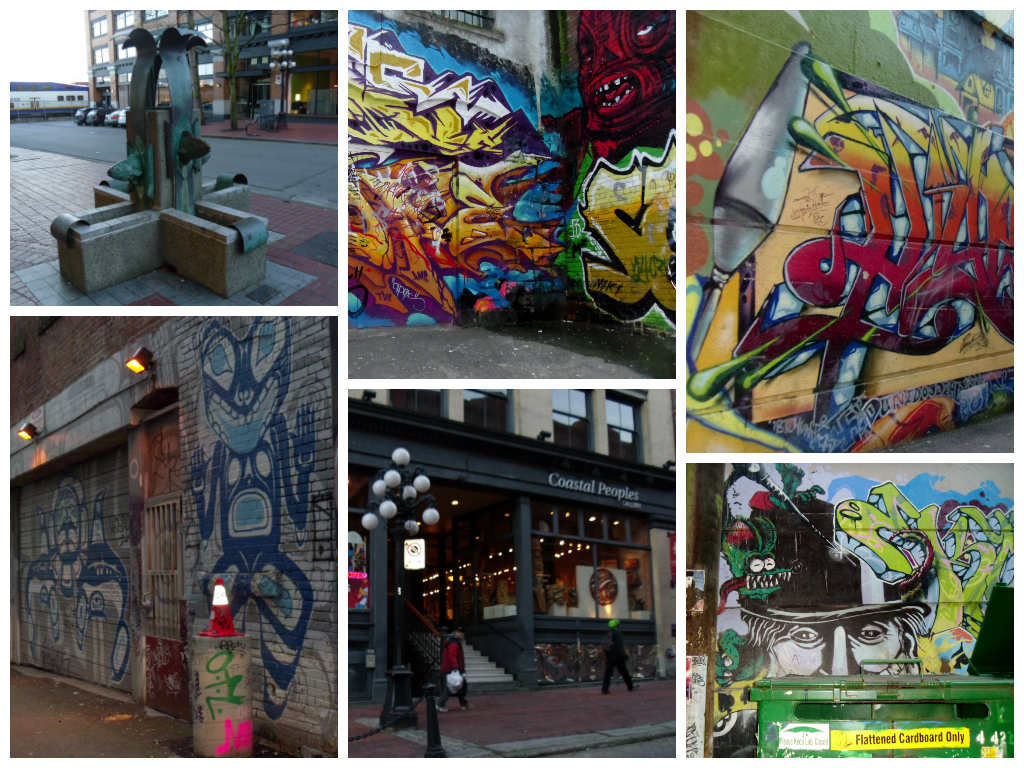
Barriers to our Research and Data Collection
Throughout this project we experienced some barriers to compiling accurate and relevant data. Even though we were using statistics from the Canadian census, we noted that this information is unlikely to be completely accurate to the chosen demographic because it did not include data from the large homeless population that occupies Gastown. Therefore, we believe the housing and income data researched and used for the depiction of Gastown only present a small part of the overall picture. When searching for data specific to Gastown, we also experienced difficulties in finding clear and distinct borders that could be utilized to find appropriate statistics. Most often Gastown is grouped into the larger boundary of the DTES as a whole, and finding statistics specific to the small neighbourhood we had chosen was challenging.
We also experienced some difficulty in finding people to talk to who currently lived in Gastown. Many of the people we encountered on the street were not residents of the area but rather were visiting, or had travelled in from various parts of the greater Vancouver area for work. Therefore, we believe their perceptions of needs for the community would be based on their use of the space for occupational, entertainment, or travel purposes and likely would not reflect the needs of the community members. We also experienced some challenges when it came to accessing and travelling the area. Although it was easy for all of us to find our way to Gastown regardless of our geographical residence, it was difficult finding affordable parking and the busy streets were difficult to navigate by vehicle while scouting out areas to photograph for our project.
Although we felt our assessment of the Gastown community was thorough and ultimately provided us with accurate data, we would like to suggest the following recommendations to facilitate assessment of this community for future assessors:
- To provide comparison of data that may differ by day and time in this area, more than one assessment should be completed (Yiu, 2012). For example, data collected during an environmental scan conducted midday on a weekday would likely provide conflicting information from an environmental scan conducted in the evening on the weekend.
- Conduct interviews and assessment outside of rush hour on weekdays. As we began our assessment at 4 pm, we found that a large proportion of people we encountered in the streets were commuters rather than residents of the area. At his time, we also found that many people were busy and said they were on their way somewhere, which made it difficult to get them to commit to being interviewed.
- To avoid expensive parking fees, have group members take transit or walk to Gastown.
- To collect relevant qualitative data from residents, have a list of interview questions prepared before conducting face-to-face interviews.
- To ensure a wide demographic is assessed, interview people from all walks of life, ages, and racial backgrounds.
- To ensure accurate data collection, conduct interviews in pairs with one person as the interviewer and one as the data recorder.
- Avoid using more than two people to interview a single person; interviewees could find this overwhelming, which may limit the reliability of data.
- To save time when assessing a community as a group, split up to cover a larger area in a minimal amount of time.
- To ensure the safety of assessors, walk in pairs.
